
Do Gay Resorts Allow Day Guests at the Pool? What to Know Before Your gay resort Costa Rica Stay
A pool gate tells you almost everything about a resort’s personality: who gets waved in, who gets asked for a room key, and how carefully the mood around the water is protected. If you are planning a gay vacation Costa Rica, especially at an intimate adults-only property, the question is practical as much as social: do gay resorts allow day guests or outside visitors at the pool?
The honest answer is: sometimes, but never assume. At a gay resort Costa Rica guests choose the property for privacy, ease, and a shared all-male atmosphere. Day visitors can change that energy fast, so policies tend to be deliberate rather than casual. A resort that feels relaxed from the outside may still have a carefully managed system behind the scenes: registered names at reception, wristbands for events, guest limits for each room, or quiet hours around the pool and bar.
That does not mean a property is trying to be exclusive in an unfriendly way. In many cases, the opposite is true. Clear access rules help everyone relax because nobody has to guess what is permitted. Overnight guests know whether they can invite a local friend for a drink. Solo travelers know the pool will not suddenly become a crowded public hangout. Couples know the adults-only atmosphere they booked will remain consistent from check-in to check-out.
Before your trip, treat pool access the same way you would treat airport transfers, restaurant reservations, or park tickets: confirm it directly. Policies can change by season, event week, occupancy level, or even by the day. During high season in Manuel Antonio, when rooms and loungers are in demand, a resort that occasionally allows day guests may pause the practice altogether. During quieter weeks, management may be more flexible if a visitor is pre-approved and respectful of the house rules.

The Short Answer: Pool Access Depends on the Resort’s Guest Policy
Most gay resorts treat pool access as part of the overnight guest experience, not as a public amenity. Some properties may offer limited day passes, event access, or host-approved outside visitors, but others keep the pool, loungers, bar areas, and clothing-optional spaces reserved for registered guests only. The safest assumption is that the pool belongs to the hotel community unless the resort clearly states otherwise.
The difference usually comes down to scale and concept. A large hotel with a public-facing pool scene may be designed for day traffic. It may have a separate bar entrance, extra service staff, a larger deck, and a social model built around visitors coming and going. A smaller all-male resort Costa Rica with only a handful of rooms may protect a quieter, more personal rhythm: morning swims, sun-warmed stone under bare feet, a late ceviche lunch, and the soft call of howler monkeys from the hills around Manuel Antonio.
At those smaller properties, even two or three outside guests can noticeably change the feel of the afternoon. They may take the last shaded loungers, shift the music volume, or make overnight guests wonder whether the pool is still a private refuge. That is why many resorts distinguish between different types of access. A day pass, if offered, may include a set time window, towel service, food or drink credit, and use of the pool only. It may not include access to rooms, clothing-optional zones, private terraces, spa areas, or after-hours events.
Host-approved visitors are usually handled differently from general day guests. If you are staying at the resort and want to invite someone you met in town, at the beach, or on an app, the respectful move is to ask reception first. The answer may be yes, no, or yes with conditions: the visitor must show identification, leave by a certain hour, pay a fee, or remain in public areas. This is normal hospitality practice, not a judgment on your guest.
If the property is adults-only or clothing-optional, the rules tend to be stricter. Not because the resort is unfriendly, but because consent, comfort, and discretion matter. A man relaxing poolside in very little fabric should never have to wonder whether the person beside him is part of the house community or simply wandering in for a look. Clothing-optional spaces depend on trust, and trust depends on boundaries that are easy to understand.
It is also worth remembering that Costa Rica resorts operate within practical limits. Pools require staffing, towels require laundering, bars must be stocked, and safety responsibilities increase with every person on property. If a resort allows outside visitors, management is taking on responsibility for behavior, alcohol service, noise, security, and the comfort of paying guests. A clearly posted policy protects the staff as much as the visitors.
Before booking, scan the resort website for phrases such as registered guests only, day pass available, visitors by approval, private property, clothing optional, or adults only. If the language is unclear, send a short message before you arrive: “I am staying three nights and may want to invite a local friend to join me at the pool for lunch. Is that allowed, and is there a fee?” A straightforward question will usually get a straightforward answer, and it prevents awkward conversations at the gate.
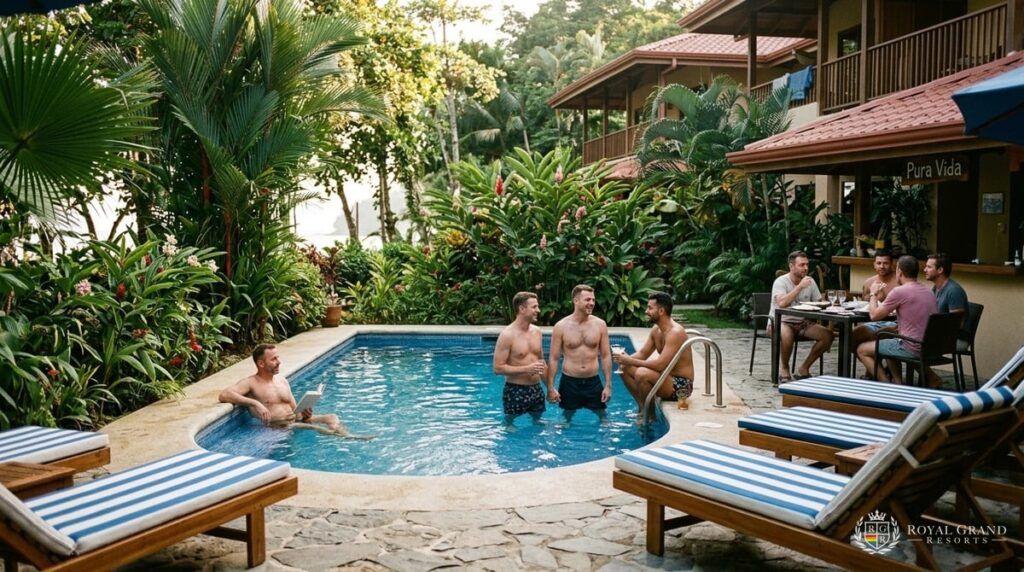
Why a Manuel Antonio gay resort may limit outside pool visitors
At an intimate Manuel Antonio gay resort, the pool is not just a rectangle of blue water. It is the social center of the stay: where solo travelers meet without awkwardness, couples read side by side, and groups of friends stretch a birthday lunch into golden hour. It is often the first place guests drift after a morning at the national park or a steep walk back from the beach, still salty, sun-warmed, and ready to do very little for the rest of the day.
Outside visitors can be lovely. They can also alter the atmosphere overnight guests paid to enjoy. Resorts that limit day guests are usually protecting three things: privacy, capacity, and continuity.
- Privacy: Gay and bisexual men often book all-male spaces because they want to drop the social armor they wear elsewhere. They may be traveling from places where affection, flirtation, or simply being shirtless around other men still carries tension. A private pool lets guests exhale. They can hold hands, nap in a swimsuit, chat openly about their lives, or enjoy a clothing-optional afternoon without feeling observed by people who have not agreed to the same environment.
- Capacity: A 30-room resort does not have infinite loungers, towels, shade, or pool space. In a tropical destination, shade is not a luxury detail; it is part of comfort and safety. If day visitors fill the best chairs, order during the lunch rush, or crowd the shallow end with drinks, overnight guests may feel that the experience they paid for has been diluted. Capacity limits keep service smooth and prevent the pool from turning into a first-come, first-served scramble.
- Continuity: When everyone is registered, staff can maintain the tone of the property with confidence. They know who is staying on site, who has allergies or accessibility needs, who should be charged to which room, and who belongs on property after dark. Continuity also helps preserve the subtle social rhythm that makes small gay resorts special: familiar faces at breakfast, easy greetings at the pool, and the sense that guests are sharing a temporary home rather than passing through a public venue.
This is especially relevant in Manuel Antonio, where a resort day can feel deliciously open: jungle humidity on your shoulders, chilled water within reach, and the easy pleasure of not explaining yourself. The destination itself encourages a slow, sensual pace. You might hear toucans in the trees, watch rain move across the hillside in the late afternoon, then slip back into the pool as the air cools. In that setting, the difference between private and public is not a small operational detail; it shapes the whole emotional texture of the stay.
There are also safety and discretion considerations unique to small properties. Staff need to know who is on site in case of a medical issue, heavy rain, a lost key, or a late-night disturbance. Guests may leave phones, sandals, sunglasses, or books on loungers while they swim. A controlled visitor policy reduces confusion and keeps the atmosphere easygoing rather than watchful. The goal is not to create suspicion; it is to remove the need for suspicion in the first place.
If you hope to socialize beyond the resort, Manuel Antonio offers plenty of ways to do that without pressing against pool rules. Meet friends for sunset drinks, book a group tour, go to dinner in town, or join an organized event where outside attendance is expected. Then return to the resort knowing the pool remains what it was meant to be: a calm, adult, gay-centered space for the people staying there.
The best rule is simple: ask early, accept the answer graciously, and do not try to sneak anyone in. A well-run gay resort is balancing hospitality with trust. When guests respect that balance, the pool feels better for everyone.